
EDUCATION
How to Create a Professional Essay Appendix in Minutes

Essay Appendix is a special feature that gives you the ability to add extra details, such as the texts of your surveys or interview questions/answers, without clogging up your readers with additional information. This essay appendix guide begins by explaining what is considered acceptable and how to construct appendixes in APA, MLA, and Chicago format and styles, and then offers a step-by-step guide to creating a professional essay appendix in just a few minutes. This guide will help you present your markers in an impressively well-organised essay where you have used appendixes, and will provide a methodology of labelling and citing sources used in appendixes.
Introduction
Your essay is finished, and suddenly you are presented with a collection of pages full of raw data, questionnaires from the surveys you completed, and interviewing transcriptions. You are aware of their worth, but you do not know where to put them? Formatting an academic document is a common source of anxiety in academic writing and an essay appendix with its style-specific rules, often makes it worse.
Students struggle to know which information to include, which structure to use, and where the material should go and they frequently lose marks in all three areas. Also, a proper essay writing service guidelines will help you to understand about what to add and what to leave out, and how to format your essay appendices correctly.
Core Ideas at a Glance
- There is rarely a reason for including supplementary material in an essay appendix; an essay appendix is not a requirement for the main argument.
- Every appendix of an essay needs to be referenced at least once in the body of the essay.
- If only a single Appendix, label it “Appendix”; if there are several appendices, label it as Appendix A/B.
- Check your institution’s guidelines before formatting an appendix, as requirements differ between citation styles.
- Examples of commonly used appendixes are raw data, surveys, transcripts, tables and consent forms.
- Avoid the common errors such as lack of referencing, poor structure, and different referencing of headings in the appendixes.
When Should You Use an Appendix in Your Essay?
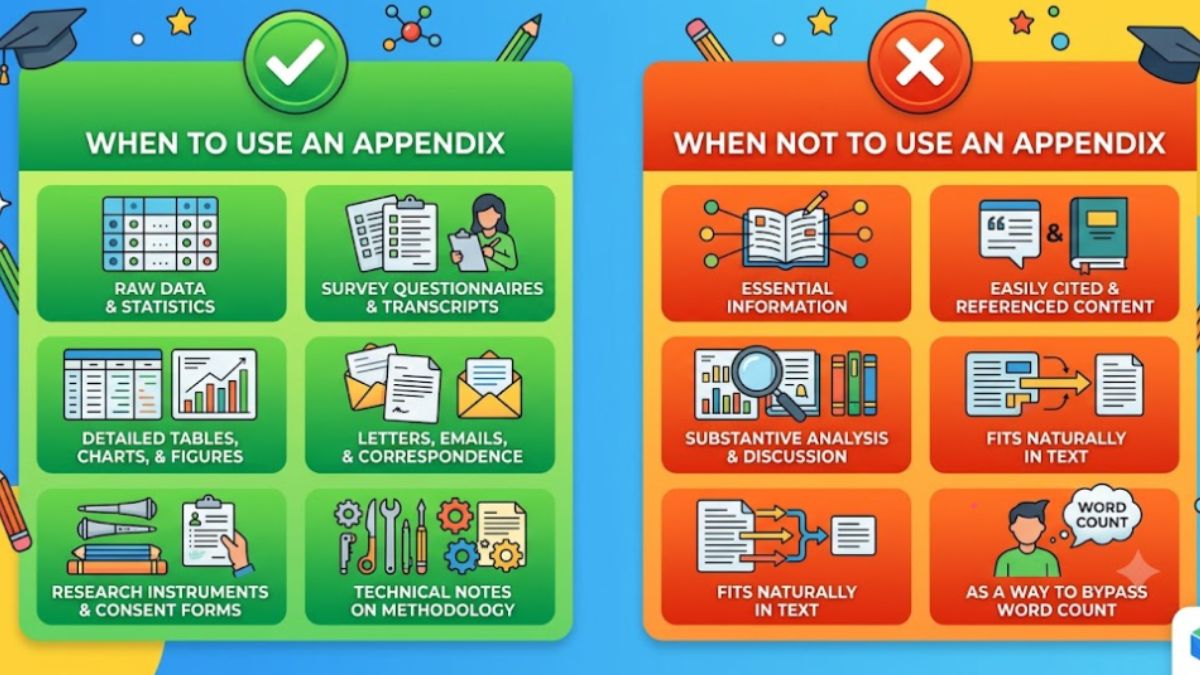
An essay appendix exists in academic writing, for content that supports your argument but is too lengthy, detailed or distracting to sit in the body.
Figure 1 When Should You Use an Appendix in Your Essay
Source: Author
| When to Use an Appendix | When NOT to Use an Appendix | Why? | Discipline Example |
|---|---|---|---|
| Raw data and statistics | Information essential to understanding your main argument | Data supports findings but would overwhelm readers if placed in-text | Psychology: Full SPSS output with 500+ responses |
| Survey questionnaires and interview transcripts | Content that can be easily cited and referenced | Questionnaires show methodology but interrupt essay flow | Business: Complete 20-question customer survey |
| Detailed tables, charts, and figures | Substantive data analysis or literature discussion | Transcripts provide depth without cluttering arguments | Nursing: 15 patient interview records |
| Letters, emails, or correspondence used in research | Information that fits naturally in the main text | Complex visuals need dedicated space for clarity | Engineering: Technical equipment specifications |
| Research instruments and consent forms | As a way to bypass the word count | Instruments validate method but are not central to findings | All disciplines: Informed consent forms |
| Technical notes on methodology | — | Notes support but do notdefine your main argument | All disciplines: Detailed methodology notes |
If you are unsure whether material belongs in the main text or in your appendix for academic essay: ask yourself: does the reader absolutely require this to understand my argument? If the answer is no, there is a good chance that it probably belongs in the appendix.
Key Takeaways
- Appendices include extra information that is not critical not essential information
- A reference should be provided in the text to each appendix.
- Handle appendixes according to a uniform system of labelling.
- Essay appendices do always require proper formatting on every assignment guideline make sure to check them first!
So, there is no need to find yourself still having problems with essay appendix or any other part of an academic college paper, the academic writers at The Academic Papers UK offer expert, personalised guidance. From formatting and structuring an appendix to model answers and editorial feedback on a full essay, the team can support you at every stage.
What to Include in an Essay Appendix (With Examples)
Not sure about what should be put in your essay appendix? Be sure to introduce supplementary material which enhances the content of your argument without disrupting the flow of it. The following is a straightforward outline of what you should typically expect to find in the appendix and how to present in a professional manner. A survey questionnaire appendix and an interview transcript appendix are the two most common types in student work:
| Category | Examples |
|---|---|
| Data & Statistics | Full datasets, SPSS output, raw numerical data |
| Research Instruments | Survey questionnaires, interview guides, test scales |
| Transcripts | Full interview transcripts, focus group discussions |
| Visual Materials | Maps, photographs, charts, diagrams, tables |
| Correspondence | Letters, emails, communication records |
| Legal Documents | Consent forms, ethics approval letters, agreements |
| Technical Information | Equipment descriptions, code, methodology details |
Good Essay Appendix Example: “Response data is collected on a 15-item survey instrument that is included in Appendix A, and/or has the full data from the data points summarised in Appendix A Table A1.
There are poor samples of essays Appendix in the form of Additional arguments supporting my thesis are included in Appendix B, an appendix must never carry a new argument.
Key Principle: Keep in mind that the essay appendix is not for the purposes of presenting new arguments, but for providing supporting information. Your essay cannot have attachments that are in addition to your essay. Tables and figures are to be found in the appendix of research data and should not be infused into the argument of a research paper.
Essay Appendix Format: APA vs. MLA vs. Chicago
It is very important that you design your essay appendix format correctly. Understand how to style such sections of a paper using three common styles of citations.
General Rules (All Styles):
- If there are appendixes, start each one on a separate page.
- Continue page numbering
- Double-space all text
- Make sure there is a descriptive title that clearly labels the problem.
APA Style (7th Edition)
| Element | APA Format | Example |
|---|---|---|
| Placement | After reference list | References page → Appendix A |
| Label | Bold, centred | Appendix A |
| Title | Bold, centred | Survey Questionnaire |
| Tables | Label with letter | Table A1, Table A2 |
Complete Appendix Page Example (APA):
[New Page]
Appendix A
Survey Questionnaire
A 15-item questionnaire was used for this purpose, which was presented to 200 respondents from January to March 2026. All participants’ responses were anonymised before analysing.
Section 1: Demographic Information
- What is your age range?
- 18–25
- 26–35
- 36–45
- 46+
- What is your highest level of education?
- High School
- Bachelor’s Degree
- Master’s Degree
- Doctorate
[Full questionnaire continues…]
In-Text Citation: Appendix A (Appendix A1 and/or Figure A) presents the results of the survey which include demographics data.
MLA Style (9th Edition)
| Element | MLA Format | Example |
|---|---|---|
| Placement | Before Works Cited | Appendix A → Works Cited |
| Label | Plain text | Appendix A |
| Order | As mentioned in text | First cited → First listed |
Complete Appendix Page Example (MLA):
[New Page]
Appendix A
Interview Transcripts
Transcripts of semi-structured interviews with 12 participants carried out from February to March 2026; these are the complete transcriptions of the interviews. To keep the information anonymous, the names of the participants have been replaced by codes (P1-P12).
Interview with P1 (15 February 2026)
Interviewer: Could you describe your experience with…
Participant: Yes, I found that…
[Full interview transcripts continue…]
In-Text Citation: Full interview transcripts are available in Appendix A.
Chicago Style
| Element | Chicago Format | Example |
|---|---|---|
| Placement | After the main text, before the notes and bibliography | Main text→ → Appendix A→ Bibliography |
| Label | Plain or bold | Appendix A |
| Order | As mentioned in text | First cited → First listed |
Complete Appendix Page Example (Chicago):
[New Page]
Appendix B
Raw Statistical Data
Complete survey responses (from January 1, 2026 to March 31, 2026) to the nationwide survey of 200 participants. Data are presented by demographic groupings and by the type of response.
Table B1: Response Distribution by Age Group
| Age Group | Number of Responses | Percentage |
|---|---|---|
| 18-25 | 45 | 22.5% |
| 26-35 | 78 | 39.0% |
| 36-45 | 52 | 26.0% |
| 46+ | 25 | 12.5% |
[Full dataset continues…]
In-Text Citation: Raw data is provided in Appendix B for verification purposes.
Remember to consult with expert assignment help to understand which instructions your professor may have. Moreover, suitable for particular guidelines concerning the essay appendix format.
How to Structure and Label Multiple Appendices
The order of your essay appendix should follow the same order in which each item is first mentioned in the essay body, with each appendix as its own unit. For making perfect labelling of appendix in the professional format, each appendix has to be in consistent formatting with the main body, numbered accordingly and cross-referenced with the main body.
| Number of Appendices | Label Format | Example |
|---|---|---|
| One | Appendix | Appendix |
| Two or more | Appendix + Capital Letter | Appendix A, Appendix B, Appendix C |
| More than 26 | Double letters | Appendix AA, Appendix BB |
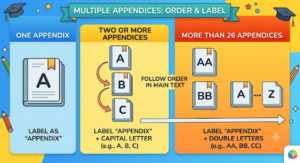
Figure 2: Structure and Label Multiple Appendices
Source: Author
Structure Checklist for Your Essay Appendix
- Each appendix starts on a separate page.
- Use a label (such as Appendix A) for each appendix.
- Every appendix is numbered and has a descriptive title.
The following is an example of Appendix Labelling Format in practice: The survey tool is included as Appendix A and complete transcripts of interviews are included as Appendix B.
How to Cite and Reference an Appendix in Your Essay
When it comes to essay writing, the appendix citation in essay, it must be formatted correctly based on each of the different writing styles. Below are examples of the three main styles across various categories, including differentiating between citing your own appendix and reproduced material.
| Citation Type | APA Example | MLA Example | Chicago Example |
|---|---|---|---|
| Single appendix | see Appendix | see Appendix | see Appendix |
| Specific appendix | see Appendix A | see Appendix A | see Appendix A |
| Parenthetical citation | (see Appendix A) | (see Appendix A) | “(see Appendix A) |
| Narrative citation | “The survey results (Appendix A) show… | Full transcripts are in Appendix A | Raw data is provided in Appendix B |
| Citing reproduced material (NEW) | (see Appendix A; adapted from Smith, 2020) | (see Appendix A; reprinted from Jones, 2019) | (see Appendix A; source: Brown, 2021) |
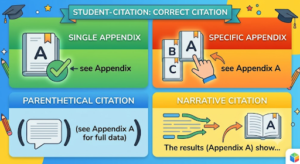
Figure 3: Cite and Reference an Appendix in Your Essay
Source: Author
Important Rules for Referencing an Appendix in Text
- To refer to a single appendix, write “ss Appendix:’ to point to a specific one among several, write “see Appendix A”.
- Parenthetical citation, e.g., This is a fact from Appendix A. (see Appendix A for full data)
- Narrative citation According to the survey results (see Appendix A),
- These are the main rules of referencing an Appendix in text, whichever style you use.
Step-by-Step: How to Create an Essay Appendix in Minutes
To write your essay appendix quickly and conveniently, follow these simple steps:
| Step | Action |
|---|---|
| Step 1 | Look for raw data or transcripts that support your argument |
| Step 2 | Group related content each appendix covers one distinct topic |
| Step 3 | Use Appendix A, B, C in order of text appearance |
| Step 4 | Start each appendix on a new page. Word: Insert > Page Break |
| Step 5 | Reference each appendix using “(see Appendix A)” |
| Step 6 | Verify every appendix is cited and formatting is consistent |
| Step 7 | Proofread the appendix and check it against your assignment guidelines. |
Essay Appendix Example and Template
Check out this example of an essay Appendix so you understand what you will need:
Example Appendix Page
Appendix A
Survey Questionnaire
This questionnaire was used to seek informed responses from 200 respondents in the period under coverage, January to March 2026.
Section 1: Demographic Information
- What is your age range?
- 18–25
- 26–35
- 36–45
- 46+
- What is your highest level of education?
- High School
- Bachelor’s Degree
- Master’s Degree
- Doctorate
[Full questionnaire continues with Sections 2-4 on following pages]
Table A1: Participant Demographics
| Age Group | Frequency | Percentage |
|---|---|---|
| 18-25 | 45 | 22.5% |
| 26-35 | 78 | 39.0% |
Example Appendix Page (Qualitative Research):
[New Page]
Appendix B
Interview Transcripts
Full transcripts from the semi-structured interviews, which were carried out with 12 participants, from February to March 2026. Participant names have been changed to codes (P1 to P12) to keep the participants anonymous. Some interviews were conducted for about 45 minutes and others for 60 minutes.
Interview with P3 (15 February 2026)
Interviewer: Could you describe your experience with…
Participant: Yes, I found that…
Interviewer: What factors influenced your decision?
Participant: The main factors were…
[Full transcripts continue for all 12 participants]
Table B1: Participant Profile
| Participant Code | Age | Gender | Occupation |
|---|---|---|---|
| P1 | 34 | Female | Teacher |
| P2 | 28 | Male | Engineer |
Quick Essay Appendix Template:
text
[New Page]
Appendix [A/B/C]: [Descriptive Title]
[Brief introduction explaining the content]
[Your supplementary content]
Common Mistakes to Avoid When Creating an Appendix
| Mistake | How to Fix It | Why It Matters |
|---|---|---|
| Including essential information | Move essential points into the main body | Your essay must stand alone without the appendix |
| Not citing appendices | Add in-text citations to every appendix | Readers would not know the appendix exists |
| Poor organisation | Use clear labels and organise by topic | Readers cannot find what they need |
| Inconsistent essay appendix format | Follow one style guide consistently | Looks unprofessional and loses marks |
| Using appendices to bypass word count | Keep for supplementary material only | Considered poor academic practice |
Conclusion
Creating a professional essay appendix is difficult. Here is an essay appendix guide to help you how to create a successful appendix for your academic essay, which will help show academic rigor and improve your writing.
Frequently Asked Questions
Q1: What should be included in an essay appendix?
For an essay appendix, items that support the research but get in the way of the thesis should be placed in an appendix, such as raw data, survey questionnaires, life history forms, interview formats/excerpts, detailed tables (and other tables as appropriate), research instruments, or consent forms.
Q2: How do you format an essay appendix?
Use a bold labelled section starting on a new page after every distinct section of text for each appendix e.g. Appendix A or Appendix B. Use descriptive title, double space all text and continue page numbering with the normal page numbering system. The format of the appendix used in an essay differs somewhat from the APA, MLA and Chicago styles, so you will need to verify the style you are using.
Q3: Where should the appendix be placed in an essay?
In APA, appendices are presented at the end of the document after the References section.They need to be placed before the Works Cited list in MLA format. In Chicago style, they are usually located at the end of the text, after the reference list. Placement is one of the main differences in essay appendix structure.
Q4: What is the difference between an appendix and a reference list?
A reference list is essentially a complete list of sources you used in an essay. A supplemental or appendixes section lists documents you created or gathered from your course of research to present as supplementary information like raw data, questionnaires, transcriptions, etc. This distinction between appendix list and reference list is the main one. The information in the appendixes is referenced in the text but not included in the reference list.

A Florida golf learning trip can be more than a warm-weather escape. When planned well, it gives you dedicated time to work with a coach, practice without rushing, and test better decisions on the course. A golf vacation in Florida is especially useful when you arrive with a focused goal rather than a long wish list of swing changes.
Florida courses also create useful learning conditions. Breezes, water hazards, firm or soft turf, and afternoon weather can require golfers to adapt their targets and shot selection. Because Florida includes both humid subtropical and tropical climate zones, early practice sessions and sensible hydration can help players protect their energy for the work that matters most.
Why Learning Trips Can Work So Well
At home, golf practice often competes with work, family, weather, and a packed schedule. A learning trip creates room to slow down and follow a sequence: instruction, practice, play, review, then rest. That structure is valuable because a golfer can test an idea while it is still fresh without trying to overhaul every part of the game.
More hours do not automatically mean better progress. Productive practice has a purpose, a target, and a way to judge the result. For example, a wedge session can focus on landing the ball near a chosen distance rather than simply hitting a large bucket. Guidance on planning practice with feedback and changing targets supports the same practical lesson: avoid aimless repetition.
Set Goals Before Packing Your Clubs
Choose no more than two main goals for the trip. Specific goals give your instructor useful context and keep each practice session from becoming a collection of unrelated swing thoughts. A goal can involve technique, scoring, or decision-making.
Examples of Useful Golf Goals
- Improve contact with short irons.
- Create a repeatable pre-shot routine.
- Control chips from tight, fluffy, and rough lies.
- Reduce penalty shots during practice rounds.
- Choose safer targets when water or bunkers guard a green.
Write each goal in plain language. “Make better contact with my pitching wedge” is easier to work on than “fix my swing.” It also gives you and your coach a clear standard for reviewing progress.
Choose the Right Learning Format
The best format depends on your experience, stamina, budget, and comfort with coaching. Before booking, ask how much individual instruction, short-game work, course play, and post-session review are included.
- Short instruction block: Best for one defined issue followed by independent practice.
- Multi-day coaching: Useful for golfers who want technique, scoring skills, and on-course application.
- Practice and play: Combines range work with realistic choices on the course.
- Small-group learning: Offers a social setting and shared drills.
- One-to-one coaching: Allows closer attention to individual habits and goals.
Build a Simple Practice Plan
Do not arrive at the range and decide what to do ball by ball. A simple two-hour block can provide enough structure while leaving room to respond to what you learn.
- Warm up for 10 minutes: Use light movement and easy swings.
- Work on one skill for 25 minutes: Stay with a single coach-approved priority.
- Test it for 20 minutes: Change clubs, targets, or distances.
- Spend 30 minutes on the short game: Include chips, pitches, and bunker shots.
- Practice putting for 20 minutes: Alternate between start-line and pace drills.
- Finish with a 15-minute challenge: Keep score to add consequence.
Afterward, record the drill, the ball-flight result, and one feeling worth keeping. Brief notes are more useful than a detailed technical diary you will not reread.
Use Feedback Without Overthinking
Feedback should simplify practice, not turn every shot into an examination. Ask your instructor for one main cause of the miss, one feel to explore, and one drill you can repeat safely at home. Video, launch-monitor numbers, and alignment aids can help, but only when they answer a specific question.
Useful Questions to Ask
- What is the main pattern behind my common miss?
- What should a solid shot feel or sound like?
- Which drill best matches this issue?
- How should I measure improvement?
- When should I stop working on this change for the day?
Take New Skills to the Course
Range success is only a starting point. On a Florida course, wind, uneven lies, water, sand, and changing yardages make every shot a decision. Use a practice round to play conservatively, follow a complete pre-shot routine, and notice whether your new skill survives when the target matters.
Track decisions as well as scores. Note whether you selected a sensible target, chose enough club, and accepted the safest miss. Better choices and more reliable contact can be meaningful signs of progress even before the scorecard changes.
Common Mistakes That Waste a Golf Trip
Trying to Fix Everything
Changing grip, posture, backswing, path, tempo, and equipment setup at once makes it difficult to tell what helped. Keep the work narrow enough to practice with confidence.
Skipping Recovery
Long days in Florida heat can drain concentration. Schedule water breaks, eat regularly, use sun protection, and leave enough time for sleep. A shorter, alert practice session is usually more valuable than extending tired repetitions.
Practicing Only the Full Swing
Putting, chipping, pitching, bunker shots, and strategy all deserve time. A learning trip is an opportunity to build scoring skills that are often easier to take from the practice area to the course.
Keep Improving After the Trip
The first month after returning home is where the trip becomes lasting improvement. Keep the plan modest and repeatable.
- Week one: Repeat the main drills from the trip.
- Week two: Test the skill during a casual round.
- Week three: Review notes and adjust one small part of the routine.
- Week four: Measure progress with a short skills test or score review.
Common Questions
How Many Days Should a Golf Learning Trip Last?
A shorter trip can work well for one focused priority. A longer stay may suit golfers who want time for lessons, short-game practice, on-course strategy, and recovery between sessions.
Should a Golfer Practice Before Taking Lessons?
Yes, but keep it simple. A few rounds or range sessions can reveal common misses and scoring frustrations. Avoid making major changes immediately before receiving professional feedback.
What Should a Golfer Bring Home From the Trip?
Bring one or two useful cues, a short drill list, notes on common misses, a realistic weekly schedule, and a simple way to measure whether the work is transferring to the course.
Conclusion
A productive Florida golf learning trip is built around clarity, not constant activity. Set limited goals, practice with intent, play enough holes to test new skills, and protect time for recovery. When you return home with a plan you can actually repeat, the value of the trip can continue well beyond the final round.

If you want to teach and make a real impact, choosing the right graduate program can shape everything from your certification path to your first job offer. A Master of Arts in Teaching, often called an MAT, sits at the point where subject knowledge meets practical classroom training. You’re not just studying education theory. You’re learning how to manage a room, design lessons, and work with actual students in ways that hold up outside a textbook.
What a Master of Arts in Teaching Actually Prepares You to Do
A Master of Arts in Teaching is built for people who want to become teachers or strengthen their route into licensed classroom work. Unlike broader education degrees that may lean heavily into policy or administration, this program stays close to teaching practice.
You usually study lesson planning, classroom management, adolescent development, assessment, and instructional methods. There’s also a strong focus on fieldwork or student teaching, which matters because a polished résumé means very little if you freeze when 25 students start talking at once.
Many MAT programs are designed for career changers and recent graduates who already know their content area but need the pedagogical training to teach it well. If you want to move from “I know this subject” to “I can teach this subject clearly,” this degree fits that lane.
Why the Program Format Matters More Than You Might Expect
A graduate degree can look great on paper and still be a logistical mess in real life. Program structure matters because you need something that works with your schedule, certification goals, and ability to complete field experiences without your life catching fire.
When you evaluate MAT program, look closely at whether the coursework is online, how internships are arranged, and how licensure support is handled. A flexible format helps if you’re working, changing careers, or balancing family responsibilities.
William Paterson University’s online MAT stands out for students who need that kind of access. The university has a long history in educator preparation, and its online setup can make graduate study more realistic for aspiring teachers who need structure without being locked into constant campus attendance. Convenience alone isn’t enough, but convenience with solid training is a powerful combo.
How Student Teaching and Clinical Experience Shape Your Readiness
Teaching looks deceptively simple from the back of a classroom. Then you step to the front and realize timing, tone, pacing, and attention management all matter at once. Clinical experience is where that reality check becomes professional growth.
A solid MAT program includes supervised practice in real school settings. You observe experienced teachers, lead lessons, receive feedback, and learn how to adjust when a plan goes sideways. That process builds the kind of confidence you can’t fake.
You also start understanding the less glamorous parts of the job: documenting progress, communicating with families, supporting different learning needs, and handling the daily unpredictability of schools. Those skills carry serious weight with hiring teams.
If your goal is licensure and classroom readiness, hands-on experience isn’t a bonus feature. It’s the engine. Without it, even the strongest coursework can feel a bit like assembling furniture without checking whether the screws are in the box.
What to Look for if You Want More Than a Credential
Not every teaching degree delivers the same value. You’re looking for more than a diploma and a ceremonial handshake. You want training that helps you become employable, capable, and adaptable in modern classrooms.
Check whether the curriculum addresses culturally responsive teaching, educational technology, differentiated instruction, and evidence-based assessment. Schools expect new teachers to do far more than lecture from a worksheet packet. You may be working with multilingual learners, students with varied support needs, and digital learning platforms from day one.
It also helps to consider institutional character. William Paterson University has a public-service orientation and a practical approach that can appeal to students who want an education grounded in community impact. That matters because strong teacher preparation is often tied to how seriously a university treats the realities of public education, not just the theory around it.
Career Outcomes and the Bigger Picture Behind the Degree
An MAT can support your path toward initial teacher certification and open doors in elementary, middle, or secondary education, depending on your concentration and state requirements. It may also position you for stronger salary potential than a bachelor’s degree alone, though pay always depends on district contracts and location.
Beyond credentials, the degree can help you enter a profession that remains essential and demanding in equal measure. Schools need teachers who can teach content, build trust, interpret data, and keep students engaged when attention spans are competing with phones, stress, and a dozen browser tabs.
If you’re serious about teaching, the right MAT helps you build those muscles before you’re fully responsible for a classroom. That preparation can reduce the shock of your first year and improve your odds of staying in the profession.
A teaching career asks a lot from you. The right graduate program should give a lot back: practical training, certification support, and a clearer path into meaningful work.

Few decisions in a family’s education journey carry as much weight as choosing the right high school. The school a teenager attends shapes not just their grades but their habits, relationships, and sense of what is possible after graduation. Parents who take an active role in that process rather than defaulting to the nearest option often find their teenager better matched to a program that fits how they learn. The range of available schools has expanded well beyond traditional district options. Charter schools, magnet programs, and specialty academies have made the search more complex and, for families willing to look carefully, more promising. Knowing what to evaluate before committing makes the process more productive and the outcome more likely to serve the student well.
Why the type of school matters
Parents comparing high schools often find that the label on the building tells them less than they expected about what a teenager’s day will actually look like. Public charter high schools serving grades 9 through 12 sit in a category of their own, built around a defined academic focus and an internationally recognized curriculum, with class sizes that stay smaller than what district schools typically allow. Picking wrong here costs a teenager four years in a setting that does not fit how they learn. The best way to answer that question is to look closely at a school like ASU Prep Academy, a public charter high school for grades 9 through 12 whose class sizes run smaller than the state average. Closer teacher contact and a clear academic track from freshman year onward follow directly from that structure.
What the academic program reveals about a school
Every high school teaches core subjects, but the depth and structure of what is offered varies considerably from school to school. Some organize their curriculum around a recognized academic framework that gives students a coherent path through all four years. Others assemble course offerings without a unifying logic, leaving students to work through requirements without a clear sense of how each piece connects to the next. Parents evaluating a school’s academic program should ask how courses are sequenced, what the school expects students to achieve by graduation, and how the curriculum connects to what colleges will ask of them.
The role of class size in how teenagers learn
One of the most direct ways a school’s structure affects a student’s daily experience is through class size. In a smaller class, a teacher can track each student’s progress, adjust the pace of instruction, and build the kind of working relationship that makes it easier to catch problems before they compound. In a larger class, individual attention is rationed by default. Teenagers who struggle with a concept may not get help until a test makes the gap visible. Parents should ask not just about average class sizes but about how teachers respond when a student falls behind. A school that keeps classes small and has a clear process for staying in contact with students and families is giving teenagers a structural advantage in how they learn, not just a more comfortable room to sit in.
How high schools approach college readiness
Getting a teenager into high school is one milestone. Getting them ready for what comes after is a different challenge. High schools vary considerably in how seriously they treat college readiness: some front-load the work into junior and senior year, while others build preparation into the full four years. The more effective approach tends to involve ongoing exposure to college-level expectations, regular feedback on academic work, and guidance on the application process that begins well before senior year. Parents should ask how the school tracks whether students are hitting the benchmarks that colleges require. A school that treats college readiness as something constructed over four years rather than crammed into the final two gives students a longer runway to build the skills and habits that matter most.
Reading a school’s culture before enrolling
Among all the factors parents research before choosing a school, culture is the hardest to quantify and the easiest to overlook. In practice, a school’s culture is visible in how staff treat students when things go wrong, whether teenagers feel known or anonymous in the building, and whether students are expected to take ownership of their learning or simply comply with rules. When visiting a school, parents should pay attention to how students and staff interact on campus. A school where students seem engaged and adults seem to know them by name is showing something real about how it operates. One where the hallways feel indifferent is showing something equally real.
How to research schools before visiting
Before setting foot on a campus, parents can gather a great deal of information from publicly available sources. School listing and review sites compile data on enrollment, grade levels, curriculum types, and other structural details that would take hours to assemble independently. Reading through what a school publishes about itself alongside information from neutral third-party sources gives parents a more complete picture before they commit time to a visit. Neither source alone is sufficient: a school’s own materials emphasize strengths, and third-party data reflects historical records that may not capture recent changes. Using both, and following up with direct questions during a campus visit, is the most reliable path to a decision that fits the student rather than just the school’s reputation.
Questions worth asking before enrolling
The most productive school visits produce answers to specific questions rather than general impressions. Parents who arrive without a prepared list often leave with a feeling but no framework for comparing what they saw. Useful questions include how the school handles a student who falls behind in a core subject, what a typical day looks like for a ninth grader, and how the school communicates with parents throughout the year. Questions about graduation outcomes, what happens after students leave, and how the school tracks its graduates are equally worth raising. These questions are not designed to catch a school off guard but to surface how it thinks about the students it serves. A school that answers them directly and with specifics is a school that has likely already thought through the same concerns the parent is raising.
-

 NEWS1 year ago
Historical Churches in Manila
-

 TOPIC3 months ago
Unveiling AvTub: Your Ultimate Guide to the Best AV Content
-

 TOPIC1 year ago
Symbols of Hope: The 15th Belenismo sa Tarlac
-

 TOPIC1 year ago
Simbang Gabi and Kakanin
-

 TOPIC1 year ago
RIZAL at 160: a Filipino Feat in Britain
-

 NEWS4 months ago
What Caused Delta Flight DL275 to Diverted LAX? A Detailed Breakdown
-

 TOPIC2 months ago
Understanding Fascisterne: Origins and Ideological Roots
-

 TOPIC1 year ago
“The Journey Beyond Fashion” – Ditta Sandico