
EDUCATION
Balancing Work, Life, and Learning: Strategies for Success


For many professionals and lifelong learners, successfully juggling the demands of work, personal commitments, and education feels like a constant challenge. The pressure and stress from overlapping responsibilities can quickly become overwhelming. Fortunately, practical strategies can help anyone move from merely coping to thriving. Exploring resources like MSU Innovative Learning can empower you to find the adaptable solutions that best fit your lifestyle and goals.
With intentional planning and the right mindset, maintaining fulfillment across work, life, and learning becomes a realistic and rewarding process. Whether you are returning to school as a working parent, advancing your career through new certifications, or seeking a better balance between your personal and professional life, real-world tactics can ease the strain. By implementing proven techniques and using flexible programs, you pave the way for growth and satisfaction across all areas of life.
This article offers research-backed, experience-driven tips to foster harmony, boost resilience, and help you create sustainable routines. From prioritizing self-care and time management to leveraging technology and establishing a supportive environment, each strategy is designed to support your success at every stage of your journey.
Effective Time Management
Time management is the keystone to balancing a busy schedule. Start by creating a structured routine that breaks time into compartments for core responsibilities and essential tasks. Digital planners, such as Google Calendar or Todoist, help organize deadlines and keep overlapping obligations in check. Breaking larger goals into smaller steps prevents overwhelm and keeps your workload manageable. Setting clear boundaries for work, study, and personal time improves focus and reduces stress, making it easier to navigate daily expectations without feeling pulled in every direction.
Establishing Clear Goals
Clarity in your ambitions paves the road to consistent progress. Set defined, realistic goals for your career, education, and personal growth. Use a mix of short-term and long-term benchmarks, revisiting and refining them as your situation evolves. SMART goals, specific, measurable, achievable, relevant, and time-bound, can help ensure you stay on course.
Creating a Supportive Environment
Building a workspace that enhances productivity is crucial. Designate a spot in your home specifically for study and work, away from common distractions. Keep the area organized and equip it with everything you need, from charging cables to textbooks and noise-cancelling headphones. Clear communication with family and roommates about your commitments helps set boundaries and minimizes interruptions during critical work or study times. Encouragement from those around you fosters a sense of accountability and emotional support.
Prioritizing Self-Care
Physical and mental well-being are the foundation of sustained productivity. Regular exercise, balanced meals, and eight hours of sleep each night strengthen cognitive function and energy reserves. Integrate short breaks and relaxation into your schedule to avoid burnout. Activities such as walking, meditation, or creative hobbies provide much-needed mental release and help maintain a positive outlook, even during demanding periods.
Leveraging Flexible Learning Options
Enrolling in flexible learning programs is a game-changer for busy adults. Part-time courses, evening or weekend classes, and online learning make it possible to pursue education without sacrificing work or personal time. Digital resources allow students to access lectures, complete assignments, and engage in discussions at their own pace, making it easier to blend learning with other responsibilities. Institutions embracing innovative formats help learners feel empowered rather than restricted by traditional schedules.
Utilizing Technology Tools
Technology can streamline nearly every aspect of your daily routine. Productivity apps and project management software, such as Trello or Notion, enhance organization, facilitate team collaboration, and keep you accountable. Online learning platforms provide easy access to high-quality materials and new skills on demand. Staying aware of the evolving tech landscape ensures you use tools that save time and maximize efficiency, both at work and in your education.
Seeking Support and Communication
No one should navigate multiple roles alone. Reach out to mentors, advisors, and colleagues for advice, encouragement, or networking opportunities. Open conversations with supervisors may reveal flexible scheduling, tuition support, or other resources that make learning more accessible while honoring work commitments. Peer groups and online forums create a community of support, offering opportunities to share insights and overcome challenges together.
Maintaining Motivation and Resilience
The journey of balancing work, life, and continuous learning is filled with both successes and setbacks. Celebrate accomplishments, no matter how small, and recognize your strides forward. Setting incremental milestones and rewarding yourself after achieving them keeps your momentum strong. Embracing setbacks as lessons rather than failures fosters resilience, supporting a forward-thinking mindset that equips you for the dynamic nature of today’s world.
Conclusion
Balancing work, life, and learning is not about achieving perfection but about creating sustainable rhythms that evolve with your needs. By managing time intentionally, setting clear goals, prioritizing well-being, and leveraging flexible learning options and technology, individuals can reduce stress while continuing to grow personally and professionally. With the right support systems and a resilient mindset, it becomes possible to thrive across all responsibilities. Small, consistent efforts compound over time, turning balance into a long-term habit rather than a constant struggle.

Essay Appendix is a special feature that gives you the ability to add extra details, such as the texts of your surveys or interview questions/answers, without clogging up your readers with additional information. This essay appendix guide begins by explaining what is considered acceptable and how to construct appendixes in APA, MLA, and Chicago format and styles, and then offers a step-by-step guide to creating a professional essay appendix in just a few minutes. This guide will help you present your markers in an impressively well-organised essay where you have used appendixes, and will provide a methodology of labelling and citing sources used in appendixes.
Introduction
Your essay is finished, and suddenly you are presented with a collection of pages full of raw data, questionnaires from the surveys you completed, and interviewing transcriptions. You are aware of their worth, but you do not know where to put them? Formatting an academic document is a common source of anxiety in academic writing and an essay appendix with its style-specific rules, often makes it worse.
Students struggle to know which information to include, which structure to use, and where the material should go and they frequently lose marks in all three areas. Also, a proper essay writing service guidelines will help you to understand about what to add and what to leave out, and how to format your essay appendices correctly.
Core Ideas at a Glance
- There is rarely a reason for including supplementary material in an essay appendix; an essay appendix is not a requirement for the main argument.
- Every appendix of an essay needs to be referenced at least once in the body of the essay.
- If only a single Appendix, label it “Appendix”; if there are several appendices, label it as Appendix A/B.
- Check your institution’s guidelines before formatting an appendix, as requirements differ between citation styles.
- Examples of commonly used appendixes are raw data, surveys, transcripts, tables and consent forms.
- Avoid the common errors such as lack of referencing, poor structure, and different referencing of headings in the appendixes.
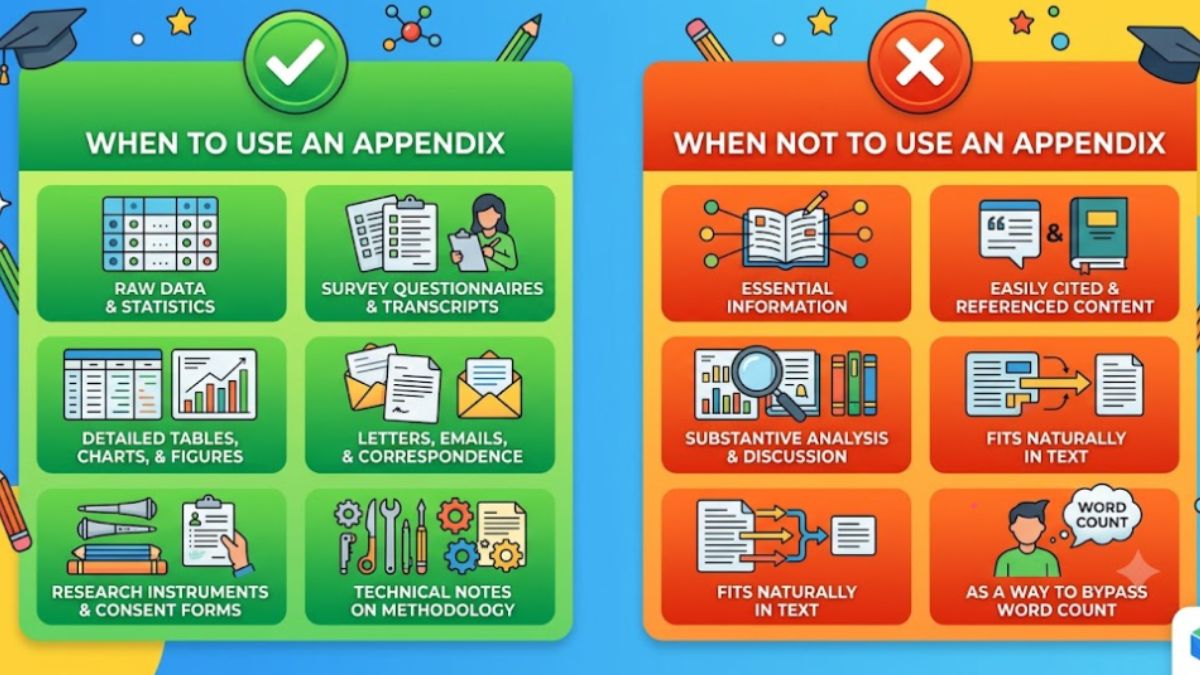
When Should You Use an Appendix in Your Essay?
An essay appendix exists in academic writing, for content that supports your argument but is too lengthy, detailed or distracting to sit in the body.
Figure 1 When Should You Use an Appendix in Your Essay
Source: Author
| When to Use an Appendix | When NOT to Use an Appendix | Why? | Discipline Example |
|---|---|---|---|
| Raw data and statistics | Information essential to understanding your main argument | Data supports findings but would overwhelm readers if placed in-text | Psychology: Full SPSS output with 500+ responses |
| Survey questionnaires and interview transcripts | Content that can be easily cited and referenced | Questionnaires show methodology but interrupt essay flow | Business: Complete 20-question customer survey |
| Detailed tables, charts, and figures | Substantive data analysis or literature discussion | Transcripts provide depth without cluttering arguments | Nursing: 15 patient interview records |
| Letters, emails, or correspondence used in research | Information that fits naturally in the main text | Complex visuals need dedicated space for clarity | Engineering: Technical equipment specifications |
| Research instruments and consent forms | As a way to bypass the word count | Instruments validate method but are not central to findings | All disciplines: Informed consent forms |
| Technical notes on methodology | — | Notes support but do notdefine your main argument | All disciplines: Detailed methodology notes |
If you are unsure whether material belongs in the main text or in your appendix for academic essay: ask yourself: does the reader absolutely require this to understand my argument? If the answer is no, there is a good chance that it probably belongs in the appendix.
Key Takeaways
- Appendices include extra information that is not critical not essential information
- A reference should be provided in the text to each appendix.
- Handle appendixes according to a uniform system of labelling.
- Essay appendices do always require proper formatting on every assignment guideline make sure to check them first!
So, there is no need to find yourself still having problems with essay appendix or any other part of an academic college paper, the academic writers at The Academic Papers UK offer expert, personalised guidance. From formatting and structuring an appendix to model answers and editorial feedback on a full essay, the team can support you at every stage.
What to Include in an Essay Appendix (With Examples)
Not sure about what should be put in your essay appendix? Be sure to introduce supplementary material which enhances the content of your argument without disrupting the flow of it. The following is a straightforward outline of what you should typically expect to find in the appendix and how to present in a professional manner. A survey questionnaire appendix and an interview transcript appendix are the two most common types in student work:
| Category | Examples |
|---|---|
| Data & Statistics | Full datasets, SPSS output, raw numerical data |
| Research Instruments | Survey questionnaires, interview guides, test scales |
| Transcripts | Full interview transcripts, focus group discussions |
| Visual Materials | Maps, photographs, charts, diagrams, tables |
| Correspondence | Letters, emails, communication records |
| Legal Documents | Consent forms, ethics approval letters, agreements |
| Technical Information | Equipment descriptions, code, methodology details |
Good Essay Appendix Example: “Response data is collected on a 15-item survey instrument that is included in Appendix A, and/or has the full data from the data points summarised in Appendix A Table A1.
There are poor samples of essays Appendix in the form of Additional arguments supporting my thesis are included in Appendix B, an appendix must never carry a new argument.
Key Principle: Keep in mind that the essay appendix is not for the purposes of presenting new arguments, but for providing supporting information. Your essay cannot have attachments that are in addition to your essay. Tables and figures are to be found in the appendix of research data and should not be infused into the argument of a research paper.
Essay Appendix Format: APA vs. MLA vs. Chicago
It is very important that you design your essay appendix format correctly. Understand how to style such sections of a paper using three common styles of citations.
General Rules (All Styles):
- If there are appendixes, start each one on a separate page.
- Continue page numbering
- Double-space all text
- Make sure there is a descriptive title that clearly labels the problem.
APA Style (7th Edition)
| Element | APA Format | Example |
|---|---|---|
| Placement | After reference list | References page → Appendix A |
| Label | Bold, centred | Appendix A |
| Title | Bold, centred | Survey Questionnaire |
| Tables | Label with letter | Table A1, Table A2 |
Complete Appendix Page Example (APA):
[New Page]
Appendix A
Survey Questionnaire
A 15-item questionnaire was used for this purpose, which was presented to 200 respondents from January to March 2026. All participants’ responses were anonymised before analysing.
Section 1: Demographic Information
- What is your age range?
- 18–25
- 26–35
- 36–45
- 46+
- What is your highest level of education?
- High School
- Bachelor’s Degree
- Master’s Degree
- Doctorate
[Full questionnaire continues…]
In-Text Citation: Appendix A (Appendix A1 and/or Figure A) presents the results of the survey which include demographics data.
MLA Style (9th Edition)
| Element | MLA Format | Example |
|---|---|---|
| Placement | Before Works Cited | Appendix A → Works Cited |
| Label | Plain text | Appendix A |
| Order | As mentioned in text | First cited → First listed |
Complete Appendix Page Example (MLA):
[New Page]
Appendix A
Interview Transcripts
Transcripts of semi-structured interviews with 12 participants carried out from February to March 2026; these are the complete transcriptions of the interviews. To keep the information anonymous, the names of the participants have been replaced by codes (P1-P12).
Interview with P1 (15 February 2026)
Interviewer: Could you describe your experience with…
Participant: Yes, I found that…
[Full interview transcripts continue…]
In-Text Citation: Full interview transcripts are available in Appendix A.
Chicago Style
| Element | Chicago Format | Example |
|---|---|---|
| Placement | After the main text, before the notes and bibliography | Main text→ → Appendix A→ Bibliography |
| Label | Plain or bold | Appendix A |
| Order | As mentioned in text | First cited → First listed |
Complete Appendix Page Example (Chicago):
[New Page]
Appendix B
Raw Statistical Data
Complete survey responses (from January 1, 2026 to March 31, 2026) to the nationwide survey of 200 participants. Data are presented by demographic groupings and by the type of response.
Table B1: Response Distribution by Age Group
| Age Group | Number of Responses | Percentage |
|---|---|---|
| 18-25 | 45 | 22.5% |
| 26-35 | 78 | 39.0% |
| 36-45 | 52 | 26.0% |
| 46+ | 25 | 12.5% |
[Full dataset continues…]
In-Text Citation: Raw data is provided in Appendix B for verification purposes.
Remember to consult with expert assignment help to understand which instructions your professor may have. Moreover, suitable for particular guidelines concerning the essay appendix format.
How to Structure and Label Multiple Appendices
The order of your essay appendix should follow the same order in which each item is first mentioned in the essay body, with each appendix as its own unit. For making perfect labelling of appendix in the professional format, each appendix has to be in consistent formatting with the main body, numbered accordingly and cross-referenced with the main body.
| Number of Appendices | Label Format | Example |
|---|---|---|
| One | Appendix | Appendix |
| Two or more | Appendix + Capital Letter | Appendix A, Appendix B, Appendix C |
| More than 26 | Double letters | Appendix AA, Appendix BB |
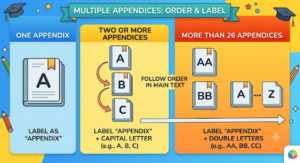
Figure 2: Structure and Label Multiple Appendices
Source: Author
Structure Checklist for Your Essay Appendix
- Each appendix starts on a separate page.
- Use a label (such as Appendix A) for each appendix.
- Every appendix is numbered and has a descriptive title.
The following is an example of Appendix Labelling Format in practice: The survey tool is included as Appendix A and complete transcripts of interviews are included as Appendix B.
How to Cite and Reference an Appendix in Your Essay
When it comes to essay writing, the appendix citation in essay, it must be formatted correctly based on each of the different writing styles. Below are examples of the three main styles across various categories, including differentiating between citing your own appendix and reproduced material.
| Citation Type | APA Example | MLA Example | Chicago Example |
|---|---|---|---|
| Single appendix | see Appendix | see Appendix | see Appendix |
| Specific appendix | see Appendix A | see Appendix A | see Appendix A |
| Parenthetical citation | (see Appendix A) | (see Appendix A) | “(see Appendix A) |
| Narrative citation | “The survey results (Appendix A) show… | Full transcripts are in Appendix A | Raw data is provided in Appendix B |
| Citing reproduced material (NEW) | (see Appendix A; adapted from Smith, 2020) | (see Appendix A; reprinted from Jones, 2019) | (see Appendix A; source: Brown, 2021) |
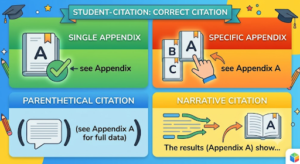
Figure 3: Cite and Reference an Appendix in Your Essay
Source: Author
Important Rules for Referencing an Appendix in Text
- To refer to a single appendix, write “ss Appendix:’ to point to a specific one among several, write “see Appendix A”.
- Parenthetical citation, e.g., This is a fact from Appendix A. (see Appendix A for full data)
- Narrative citation According to the survey results (see Appendix A),
- These are the main rules of referencing an Appendix in text, whichever style you use.
Step-by-Step: How to Create an Essay Appendix in Minutes
To write your essay appendix quickly and conveniently, follow these simple steps:
| Step | Action |
|---|---|
| Step 1 | Look for raw data or transcripts that support your argument |
| Step 2 | Group related content each appendix covers one distinct topic |
| Step 3 | Use Appendix A, B, C in order of text appearance |
| Step 4 | Start each appendix on a new page. Word: Insert > Page Break |
| Step 5 | Reference each appendix using “(see Appendix A)” |
| Step 6 | Verify every appendix is cited and formatting is consistent |
| Step 7 | Proofread the appendix and check it against your assignment guidelines. |
Essay Appendix Example and Template
Check out this example of an essay Appendix so you understand what you will need:
Example Appendix Page
Appendix A
Survey Questionnaire
This questionnaire was used to seek informed responses from 200 respondents in the period under coverage, January to March 2026.
Section 1: Demographic Information
- What is your age range?
- 18–25
- 26–35
- 36–45
- 46+
- What is your highest level of education?
- High School
- Bachelor’s Degree
- Master’s Degree
- Doctorate
[Full questionnaire continues with Sections 2-4 on following pages]
Table A1: Participant Demographics
| Age Group | Frequency | Percentage |
|---|---|---|
| 18-25 | 45 | 22.5% |
| 26-35 | 78 | 39.0% |
Example Appendix Page (Qualitative Research):
[New Page]
Appendix B
Interview Transcripts
Full transcripts from the semi-structured interviews, which were carried out with 12 participants, from February to March 2026. Participant names have been changed to codes (P1 to P12) to keep the participants anonymous. Some interviews were conducted for about 45 minutes and others for 60 minutes.
Interview with P3 (15 February 2026)
Interviewer: Could you describe your experience with…
Participant: Yes, I found that…
Interviewer: What factors influenced your decision?
Participant: The main factors were…
[Full transcripts continue for all 12 participants]
Table B1: Participant Profile
| Participant Code | Age | Gender | Occupation |
|---|---|---|---|
| P1 | 34 | Female | Teacher |
| P2 | 28 | Male | Engineer |
Quick Essay Appendix Template:
text
[New Page]
Appendix [A/B/C]: [Descriptive Title]
[Brief introduction explaining the content]
[Your supplementary content]
Common Mistakes to Avoid When Creating an Appendix
| Mistake | How to Fix It | Why It Matters |
|---|---|---|
| Including essential information | Move essential points into the main body | Your essay must stand alone without the appendix |
| Not citing appendices | Add in-text citations to every appendix | Readers would not know the appendix exists |
| Poor organisation | Use clear labels and organise by topic | Readers cannot find what they need |
| Inconsistent essay appendix format | Follow one style guide consistently | Looks unprofessional and loses marks |
| Using appendices to bypass word count | Keep for supplementary material only | Considered poor academic practice |
Conclusion
Creating a professional essay appendix is difficult. Here is an essay appendix guide to help you how to create a successful appendix for your academic essay, which will help show academic rigor and improve your writing.
Frequently Asked Questions
Q1: What should be included in an essay appendix?
For an essay appendix, items that support the research but get in the way of the thesis should be placed in an appendix, such as raw data, survey questionnaires, life history forms, interview formats/excerpts, detailed tables (and other tables as appropriate), research instruments, or consent forms.
Q2: How do you format an essay appendix?
Use a bold labelled section starting on a new page after every distinct section of text for each appendix e.g. Appendix A or Appendix B. Use descriptive title, double space all text and continue page numbering with the normal page numbering system. The format of the appendix used in an essay differs somewhat from the APA, MLA and Chicago styles, so you will need to verify the style you are using.
Q3: Where should the appendix be placed in an essay?
In APA, appendices are presented at the end of the document after the References section.They need to be placed before the Works Cited list in MLA format. In Chicago style, they are usually located at the end of the text, after the reference list. Placement is one of the main differences in essay appendix structure.
Q4: What is the difference between an appendix and a reference list?
A reference list is essentially a complete list of sources you used in an essay. A supplemental or appendixes section lists documents you created or gathered from your course of research to present as supplementary information like raw data, questionnaires, transcriptions, etc. This distinction between appendix list and reference list is the main one. The information in the appendixes is referenced in the text but not included in the reference list.

Introduction
Many parents consider enrichment classes for toddlers when daily routines start to feel less engaging for their child, especially during stages of rapid growth and curiosity. While some toddlers remain content with familiar toys and environments, others begin to seek more structured interaction, varied activities, and new forms of stimulation. These changes can appear gradually, making it difficult to determine whether they signal readiness for additional learning support. Instead of focusing on milestones alone, observing behaviour patterns often provides clearer insight into how a child responds to their surroundings. When routines at home no longer hold attention in the same way, it becomes useful to explore whether guided environments can support continued development without disrupting a child’s natural pace of growth.
1. Rapid Language Development and Expression
Toddlers who begin forming short phrases or showing interest in conversations often benefit from environments that encourage verbal interaction. When children actively respond to questions or attempt to describe their surroundings, they demonstrate readiness for guided communication exercises. These moments often occur during everyday activities, where children start linking words to actions or objects with increasing confidence. Enrichment settings provide structured opportunities to practise these skills, which help reinforce clarity in speech and understanding. Exposure to group activities also introduces new vocabulary through songs, storytelling, and guided play, allowing children to hear language used in different contexts. Over time, consistent interaction in such settings supports stronger communication habits that continue beyond the classroom.
2. High Levels of Physical Activity
Some toddlers display constant movement throughout the day, which can become difficult to manage within limited home spaces. This level of activity suggests a need for environments that support safe and purposeful movement rather than unrestricted energy. Without direction, physical restlessness may lead to frustration, especially when space or routine limits exploration. Classes designed around movement allow children to channel energy into coordinated actions, helping them develop balance, control, and awareness of their surroundings. Structured activities also introduce simple instructions that encourage children to follow patterns, such as moving in sequence or responding to cues. These experiences gradually shape how children regulate their energy while staying engaged, which benefits both physical development and daily behaviour.
3. Growing Awareness of Other Children
A shift from solitary play to observing or approaching other children often indicates readiness for social interaction. Toddlers who begin to notice peers may not yet know how to engage, yet their interest reflects a growing awareness of shared environments. This stage can appear in simple ways, such as watching others play or attempting to imitate actions. Group-based enrichment introduces basic social structures where children learn to take turns, share materials, and respond to others within guided settings. These interactions may seem small at first, yet they build familiarity with social expectations over time. As children grow more comfortable in group environments, they begin to understand how their actions relate to others, which supports early social development.
4. Curiosity About Sensory Experiences
Toddlers frequently explore the world through touch, sound, and movement, yet some show a stronger inclination towards these experiences. When children repeatedly engage with textures, rhythms, or visual patterns, they benefit from activities that expand these interests in a controlled way. At home, it can be difficult to provide varied sensory input without creating disruption or mess, which limits how much exploration can take place. Sensory-based classes offer environments where children can interact with different materials freely while remaining safe. These sessions encourage children to experiment with cause and effect, such as how objects respond to movement or sound. Over time, this type of exploration supports cognitive development by helping children process and respond to different stimuli more effectively.
5. Reduced Interest in Familiar Activities
Parents may notice that their child quickly loses interest in toys or activities that once held attention, which can feel unexpected when routines previously worked well. This shift often reflects a need for more complex or varied stimulation rather than a lack of focus. When children outgrow familiar activities, they may move quickly between options without settling into any one task. Enrichment environments introduce new materials, guided tasks, and structured play that extend attention spans by presenting gradual challenges. These settings also reduce repetition, which helps maintain interest over longer periods. As children engage with new experiences, they begin to develop problem-solving skills and patience, which support their ability to handle more structured learning in the future.
Conclusion
Recognising readiness for enrichment involves observing how a toddler interacts with their environment rather than focusing on age alone. Changes in behaviour, curiosity, and energy levels provide useful indicators of when additional support may be beneficial. When these signs appear, structured activities can complement home routines and provide new opportunities for growth while maintaining a balanced approach to early development.
Contact MapleBear Lavender to explore enrichment classes for toddlers that support your child’s development.

Singapore’s education system has long been recognised for its academic excellence, continually adapting to prepare students for an increasingly complex and technology-driven world. As teaching approaches shift towards deeper understanding, critical thinking, and real-world application, the expectations placed on students have also evolved. Today’s learners are encouraged not only to solve mathematical problems correctly but also to explain their reasoning, think creatively, and apply concepts in unfamiliar situations.
Against this backdrop, Maths Tuition Singapore has become more than an avenue for improving examination scores. It now plays an important role in helping students develop the confidence, analytical thinking, and resilience required for long-term academic success. Parents are increasingly seeking tuition programmes that complement school learning while equipping children with the skills needed for Singapore’s future-ready education framework.
Understanding Singapore’s Shift Towards Future-Ready Education
Education in Singapore continues to evolve beyond traditional memorisation. Schools now place greater emphasis on nurturing independent learners who can think critically, collaborate effectively, and solve complex problems across various disciplines.
This transformation has influenced the way mathematics is taught in classrooms. Students are expected to:
- Understand mathematical concepts rather than memorise formulas.
- Explain their methods using logical reasoning.
- Apply mathematical knowledge to real-life situations.
- Solve unfamiliar and multi-step problems confidently.
- Develop perseverance when tackling challenging questions.
These expectations require students to build strong conceptual foundations, making personalised support increasingly valuable outside the classroom.
Why Mathematics Remains a Core Skill for the Future
Mathematics extends far beyond classroom assessments. It forms the basis of many future careers and everyday decision-making, making it one of the most valuable lifelong skills.
Some areas where mathematical thinking is essential include:
| Future Skill | How Mathematics Supports It |
| Critical Thinking | Evaluating information logically and making informed decisions |
| Data Literacy | Understanding graphs, statistics and trends |
| Technology | Supporting coding, artificial intelligence and engineering concepts |
| Financial Literacy | Budgeting, investments and managing personal finances |
| Problem Solving | Analysing situations and identifying practical solutions |
Students who build strong mathematical reasoning early often find it easier to adapt to new learning challenges throughout secondary school and beyond.
How Maths Tuition Singapore Is Changing to Meet Modern Learning Needs
Traditional tuition often focused primarily on repetitive practice and examination preparation. While practice remains important, today’s tuition centres are adopting more holistic teaching strategies that align with Singapore’s evolving curriculum.
Modern Maths Tuition Singapore programmes now place greater emphasis on helping students understand why mathematical concepts work rather than simply memorising procedures.
Many quality tuition programmes now include:
- Step-by-step conceptual explanations.
- Guided problem-solving strategies.
- Exposure to higher-order thinking questions.
- Regular progress monitoring.
- Opportunities to ask questions in smaller learning environments.
This balanced approach enables students to become more confident learners rather than passive recipients of information.
Supporting Different Learning Styles
Every child learns differently. Some grasp concepts quickly through visual explanations, while others benefit from repeated practice or personalised guidance.
Effective mathematics tuition recognises these differences by adapting teaching methods to individual learning needs.
For example:
- Visual learners benefit from diagrams and graphical representations.
- Analytical learners enjoy understanding logical reasoning behind formulas.
- Practical learners improve through real-world applications and hands-on examples.
- Reflective learners gain confidence through structured revision and feedback.
This personalised approach often helps students overcome learning gaps that may develop in larger classroom settings.
Building Confidence Alongside Academic Performance
One of the most overlooked benefits of quality tuition is the improvement in student confidence.
Many students struggle with mathematics not because they lack ability, but because they lose confidence after repeated mistakes or misunderstandings. When concepts are explained clearly and students experience gradual success, their attitude towards learning often changes significantly.
Confident learners are more likely to:
- Participate actively during school lessons.
- Attempt challenging examination questions.
- Develop greater resilience after making mistakes.
- Enjoy learning instead of fearing mathematics.
Confidence becomes a powerful driver of long-term academic improvement.
The Importance of Developing Higher-Order Thinking Skills
Singapore’s mathematics examinations increasingly assess students’ ability to apply concepts in unfamiliar contexts.
Rather than asking straightforward computational questions, assessments frequently require students to:
- Interpret complex word problems.
- Identify relevant mathematical concepts.
- Combine multiple topics in one solution.
- Justify their reasoning clearly.
These higher-order thinking skills cannot be developed through memorisation alone.
Effective tuition encourages students to analyse questions carefully, identify patterns, and approach problems systematically, preparing them for both examinations and future academic challenges.
How Parents Can Choose the Right Maths Tuition Singapore Programme
Not every tuition programme offers the same learning experience. Parents should evaluate several factors before making a decision.
Consider the following checklist:
| What to Look For | Why It Matters |
| Experienced tutors | Clear explanations improve understanding |
| Small class sizes | Greater individual attention |
| Curriculum alignment | Supports current MOE syllabus |
| Regular assessments | Tracks learning progress effectively |
| Concept-focused teaching | Builds lasting understanding |
| Positive learning environment | Encourages confidence and motivation |
Parents should also observe whether a tuition programme encourages students to ask questions and develop independent thinking rather than relying solely on model answers.
The Role of Mavis Tutorial Centre in Supporting Students
Many established tuition providers have adapted their teaching approaches to reflect Singapore’s evolving education landscape. Among them, Mavis Tutorial Centre has built a reputation for supporting students across different academic levels through structured lessons that reinforce school learning.
Rather than focusing solely on examination preparation, the centre places emphasis on strengthening conceptual understanding, consistent practice, and progressive skill development. This balanced approach helps many students build confidence while keeping pace with changing curriculum expectations.
As parents explore different Maths Tuition Singapore options, choosing a learning environment that supports both academic achievement and long-term development can make a meaningful difference.
Practical Tips for Students to Maximise Tuition Benefits
Attending tuition alone does not guarantee improvement. Students should actively participate in the learning process to gain the greatest benefit.
Some practical strategies include:
- Review school lessons before each tuition class.
- Ask questions whenever concepts are unclear.
- Complete homework independently before seeking help.
- Revise regularly instead of studying only before examinations.
- Learn from mistakes by reviewing incorrect solutions carefully.
- Set realistic learning goals for continuous improvement.
Developing consistent study habits often leads to stronger understanding and better examination performance over time.
Preparing Students for Lifelong Success
Singapore’s education system continues to prepare students for a rapidly changing future where adaptability, critical thinking, and problem-solving are increasingly valuable.
Mathematics remains central to developing these essential competencies. As learning expectations evolve, quality Maths Tuition Singapore programmes are also transforming to provide more personalised support, deeper conceptual learning, and greater emphasis on independent thinking.
When students receive the right guidance, consistent encouragement, and opportunities to strengthen their understanding, they become better equipped not only for examinations but also for future academic pathways and professional careers.
Choosing a tuition programme that aligns with Singapore’s future-ready education goals can help students develop confidence, resilience, and the lifelong learning skills needed to thrive in an ever-changing world.
Here’s an expanded version with the domain naturally integrated into the paragraph instead of appearing on a separate line.
Final Thoughts
As Singapore continues to innovate its education system, parents and students should look beyond short-term examination preparation and focus on building strong mathematical foundations for lifelong success. A thoughtful approach to Maths Tuition Singapore can empower learners with the confidence, resilience, and analytical skills needed to overcome academic challenges while preparing for future opportunities. By choosing a learning environment that nurtures conceptual understanding, encourages independent thinking, and supports consistent progress, students can develop the skills required to excel both inside and outside the classroom. Parents who wish to explore effective learning approaches and gain further insights can visit mavistutorial.com to learn more about how Mavis Tutorial Centre supports students on their educational journey.
-

 NEWS12 months ago
Historical Churches in Manila
-

 TOPIC12 months ago
Symbols of Hope: The 15th Belenismo sa Tarlac
-

 TOPIC12 months ago
RIZAL at 160: a Filipino Feat in Britain
-

 TOPIC12 months ago
“The Journey Beyond Fashion” – Ditta Sandico
-

 TOPIC6 days ago
Unveiling AvTub: Your Ultimate Guide to the Best AV Content
-

 TOPIC12 months ago
5 Must-Have Products From Adarna House to Nurture Your Roots
-

 TOPIC12 months ago
Filipino, alternative language course at Moscow State University
-
 TOPIC12 months ago
“Recuerdos de Filipinas – Felix Laureano”