
TOPIC
5 Things To Know Before Booking Moving Companies In New Jersey


Hiring movers in New Jersey can help to simplify a relocation, yet selecting the incorrect company may lead to the emergence of additional issues. Poor communication, insurance coverage, unclear pricing, or lack of experience can lead to delays and unforeseen expenses.
You also might discover that a particular company is good at apartments but unprepared for fragile items, office equipment, and long-distance moves. Each move requires various needs, and the cheapest quote is not necessarily the best one.
You should take time to compare what each company offers before you book and how well their services suit your move. Check its credentials, pricing, experience, protection measures, and availability before making a decision. This can assist you in preventing unnecessary complications and planning your move with more confidence.
By taking a closer examination of these five factors, you can select a moving company in New Jersey with greater confidence.
1. Verify Licensing and Insurance
Before booking any New Jersey movers, check whether the company is properly licensed and insured. A legitimate moving company would be in a position to give their licensing information and how your belongings are covered during the moving process. This will let you know what kind of protection you have in case anything goes wrong.
Much attention also should be paid to insurance. Enquire about what is insured, what the restrictions are, and whether other insurance is provided on valuable or delicate objects. Request particular coverage information prior to signing an agreement.
You should also inquire whether the company is prepared to take care of your kind of relocation. The relocation of apartments can include lifts, staircases, limited walkways, car parking, or building parameters. Planning can be enhanced with experience of these details.
2. Compare Moving Services and Pricing

Price is an important part of your decision, but comparing only the final number can be misleading. Moving companies may structure estimates differently, so check what each quote actually includes. Ask whether loading, unloading, transportation, packing, furniture protection, disassembly, reassembly, or other services are included.
A clear estimate should also explain possible additional charges. These may relate to stairs, extra stops, packing materials, storage, or other circumstances. Understanding these costs before moving day can reduce the risk of unexpected expenses.
Also, compare the level of service behind each price. One company may offer basic transportation, while another may provide packing and furniture protection. A higher quote may make sense if it includes services you would otherwise arrange separately. Therefore, compare value instead of choosing only the lowest estimate.
3. Check Experience with Your Move Type
Every relocation has different requirements, so experience should match the type of move you are planning. A residential move may involve household furniture and fragile belongings, while an office relocation can involve desks, computers, electronics, and business equipment. Long-distance moves may require additional planning for transportation and delivery.
Ask whether the company regularly handles moves similar to yours. Ask how it handles bulky, fragile, valuable, or difficult-to-access items. This matters if you have antiques, artwork, pianos, large furniture, or electronics.
Experience also matters when your property presents access challenges. Narrow staircases, elevators, limited parking, or restricted loading areas can affect the moving process. A company familiar with these situations can plan equipment, staffing, and timing more effectively.
4. Review Packing and Furniture Protection

Packing is often one of the most time-consuming parts of moving, so find out exactly what support a company offers. Some companies provide full packing, while others offer partial packing or fragile-item assistance. Knowing your options helps you decide how much work to handle.
Ask what materials and techniques are used to protect your belongings. Furniture may need moving blankets, protective wrapping, or shrink wrap during loading and transportation. Fragile items may require additional padding and careful packing to reduce the chance of damage.
Confirm whether furniture disassembly and reassembly are included. Large beds, tables, desks, and other pieces may need to be taken apart for access. Clarifying these details in advance can prevent confusion on moving day and help you prepare your home properly.
5. Confirm Availability and Moving Details
Once you have found a company that fits your needs, confirm the practical details before booking. Start with the moving date and expected arrival window. If your schedule is tight, ask how delays or changes are handled.
Next, provide accurate information about both locations. Mention stairs, elevators, parking limits, narrow entrances, building rules, and other access concerns. For apartment or condominium moves, you may also need to check whether the building requires a Certificate of Insurance or specific moving hours.
Finally, confirm the services, estimated cost, payment terms, cancellation policy, and contact information in writing. If you need packing, storage, furniture assembly, or specialty handling, make sure those services appear in the agreement. Clear documentation gives you a useful reference and helps both sides understand what has been arranged.
Conclusion
Booking a moving company in New Jersey requires more than comparing a few prices. You need to check licensing, insurance, service details, experience, protection methods, and availability before making your decision.
These factors can affect both the cost and the overall moving experience. Start by identifying what your move requires, then compare companies based on how well they can meet those needs. Ask questions whenever a quote or service description is unclear.
With the right information in hand, you can avoid common surprises and choose a moving company that fits your schedule, belongings, property, and budget.

When a loved one dies, selling a house, condominium, vacant lot, or other real estate can seem like the most practical next step. In Wilmington, that property may also carry years of family memories, ongoing insurance and maintenance costs, and questions from heirs who want clarity. Speaking with a Wilmington probate attorney before listing the property can help a personal representative understand the legal process and avoid decisions that create unnecessary delay or conflict.
An estate sale is not simply a standard real estate transaction with a different seller’s name on the contract. The will, deed, court appointment, creditor claims, ownership structure, and tax considerations can all affect who has authority to sell and how the proceeds must be handled. Asking focused questions early can make it easier to preserve the property and keep beneficiaries informed.
Do I Have Legal Authority to Sell This Property?
This is the first question to ask because being named in a will does not always confer immediate authority to act. An executor named in a will generally seeks appointment as the estate’s personal representative. If there is no will, an eligible person may ask the court to appoint an administrator. Banks, title companies, buyers, and real estate professionals may require proof of that appointment before relying on the representative’s authority.
Ask whether Letters Testamentary or Letters of Administration are needed before you sign a listing agreement, accept an offer, or authorize repairs. Also, ask whether the estate should be opened in New Hanover County or another North Carolina county. The appropriate venue is often connected to where the deceased lived at the time of death, not necessarily to where the property is located.
It is also wise to ask whether the will contains a specific power to sell real estate. Under North Carolina’s rules governing the sale of real estate property, a will that grants the personal representative authority to sell can eliminate the need for a separate court proceeding when a sale is necessary to pay estate debts and claims. The exact language of the will and the reason for the sale matter.
Does the Property Actually Need to Go Through Probate?
Before treating a home as estate property, ask the attorney to review the deed and any related ownership documents. A house held solely in the deceased person’s name may require probate administration. However, property owned with another person under a survivorship arrangement, held in a trust, or subject to other transfer arrangements may follow a different path.
This review is particularly important for Wilmington families with blended households, second homes near the coast, inherited property, or land shared among relatives. An old deed may contain language that changes who owns the property after death. A will may control some assets, but it does not automatically override every ownership arrangement.
Ask for a plain-language explanation of who currently holds legal title, who has an interest in the property, and what documents the closing attorney will likely need. The estate procedures available through North Carolina’s court system can also help families understand the basic roles of the clerk, personal representative, heirs, and beneficiaries.
Are There Debts, Claims, or Costs That Could Affect the Sale?
A property may appear to be the estate’s largest asset, but the gross sales price is not necessarily the amount available for distribution. Before selling, ask about mortgages, property taxes, homeowners’ association assessments, utility balances, repair bills, insurance premiums, liens, and funeral or administration expenses. The estate may also receive creditor claims that must be evaluated under the probate process.
Ask whether the sale is necessary to pay valid estate obligations or whether the property could be transferred to beneficiaries instead. The answer may affect the timing of the sale, the court process, and the records the representative should maintain. Do not use sale proceeds for personal expenses or informal family payments until you understand the estate’s obligations.
Records to Keep From the Beginning
- Mortgage statements, tax bills, insurance notices, and association correspondence.
- Invoices for necessary repairs, cleaning, lawn care, security, and utilities.
- Written offers, appraisal reports, broker opinions, and closing documents.
- A log showing estate funds received and all estate-related payments made.
How Should We Set a Fair Price and Protect the Property Until Closing?
Ask how to document that the estate is pursuing a reasonable sale price. A professional appraisal, comparative market analysis, or both may be helpful depending on the property and the circumstances. This is especially important if a beneficiary, family member, tenant, or business associate wants to purchase the property. A transparent process can help demonstrate that the representative acted in the estate’s best interests rather than favoring any one person.
Property protection also matters. Coastal weather, humidity, vacant-home risks, storm preparation, and deferred maintenance can quickly affect a Wilmington property’s condition and marketability. Ask whether insurance remains adequate while the property is vacant, who may enter the home, how valuables should be inventoried, and which repairs are appropriate before listing.
Photograph rooms and significant personal property before cleaning or removing items. Keep receipts for work completed, and avoid disposing of furniture, jewelry, documents, or other belongings until ownership and distribution questions have been addressed.
What Happens to the Sale Proceeds After Closing?
Ask this question before accepting an offer, not after the closing check arrives. Proceeds should generally be handled through the estate’s financial records and used in accordance with the estate’s obligations. The personal representative may need to account for closing costs, valid debts, taxes, administrative expenses, and eventual distributions to the people entitled to inherit.
Ask whether a separate estate bank account is appropriate, what accounting will be required, and when distributions can safely be made. If the property appreciated, produced rental income, or was sold during estate administration, there may be tax questions that should be reviewed with qualified legal and tax advisers.
Conclusion: Get Answers Before the Listing Goes Live
Selling estate property can be an important step toward resolving an estate, but it should begin with a clear understanding of authority, ownership, debts, valuation, and distribution. A careful legal review before the property is listed can help Wilmington families protect the estate, keep the transaction organized, and move forward with greater confidence.
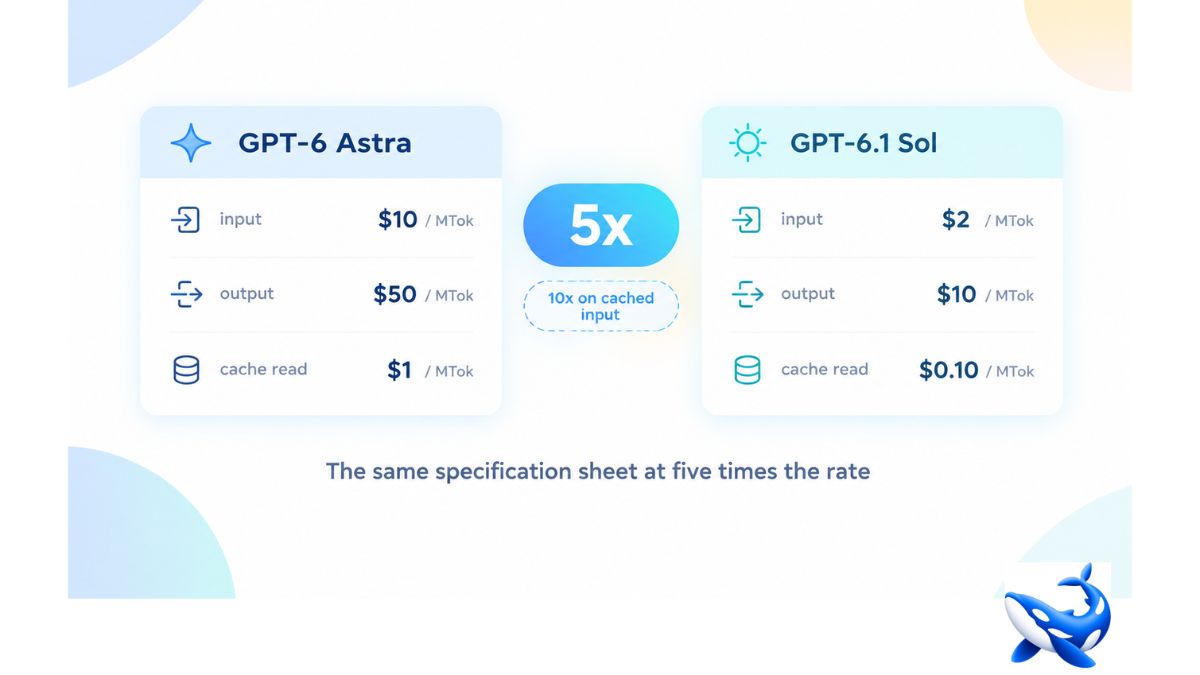
The GPT-6 Astra pricing card reads $10 per million input tokens and $50 per million output, with cached input at $1 and cache writes at $12.50 — the top of OpenAI’s current line, and exactly five times the rate of the model one rung below it. The GPT-6 Astra endpoint is metered here at list rate with no markup, so every multiple in this article can be checked against an invoice rather than a slide.
Five is a round number, and round numbers are usually a positioning decision rather than a measurement. This one happens to be both: the 5× is literal and uniform on the two headline directions, and it stops being uniform the moment you look at the cache.
What the rate card actually says
Two cards, side by side, with nothing rounded off:
| (vendor rate cards) | GPT-6 Astra | GPT-6.1 Sol | multiple |
| input, per million tokens | $10 | $2 | 5× |
| output, per million tokens | $50 | $10 | 5× |
| cache read | $1 | $0.10 | 10× |
| cache write | $12.50 | $2.50 | 5× |
| advertised context | 1.05M tokens | 1.05M tokens | identical |
| maximum output | 128K tokens | 128K tokens | identical |
| reasoning ladder | low → max | low → max | identical |
| above 272K input (our card) | $20 / $75 | $4 / $15 | 5× |
That table is the whole price story for the pair, and it is worth reading in two passes: once down the right-hand column, and once across the bottom three rows of the left.
The directions are not equally expensive
The headline multiple is five. The cache-read multiple is ten, and that difference is where budgets actually go wrong.
A cached input token on Astra costs $1 per million. The same token on Sol costs $0.10. That is not a 5× step; it is a 10× step — the discount for a stable prefix is twice as deep on the cheaper model. Expressed as a share of each model’s own input rate, Sol’s cache read is 5% of its input price and Astra’s is 10%.
Cache writes behave the other way, and consistently: $12.50 on Astra against $2.50 on Sol is 5×, and on both models a cache write costs 1.25× the model’s own input rate. So the write side is a clean 5× and the read side is a 10×.
For a pipeline whose input is mostly a reused prefix — a long system prompt, a fixed tool schema, a document the conversation keeps returning to — the effective multiple is therefore *above* 5×, because the direction you are buying most of is the one discounted least. Run the arithmetic on your own cache-hit rate before assuming the headline.
One quieter fact from the same cards: Sol’s cache read of $0.10 is half what the model it replaces charged, $0.20. The improvement is real and nobody has made a headline of it, which is usually a sign that the cache line is read by the people who care and skipped by everyone else.
Five times the price for the same specification sheet
Here is the part that decides most procurement arguments.
Astra and Sol advertise the same 1.05M-token context window, the same 128K maximum output, and the same low-to-max reasoning ladder. Nothing in the specification table explains the price step. The vendor’s own explanation is a one-line positioning claim — that Sol delivers *”near-Astra performance for complex work at a lower cost”* — which is an argument about the marginal value of the top rung rather than about its specification.
There is exactly one place the two cards diverge beyond price, and it runs the other way. Astra’s ladder starts at low rather than `none`, and the model is served with fixed sampling: temperature, top_p and logprobs are not exposed as adjustable parameters. Sol does not carry that restriction. So the more expensive model is, on one narrow axis, the less configurable — which is worth knowing before a team pays the step to get access to a capability it does not extend.

The tier above 272K tokens
Both OpenAI models in this generation are billed in two bands, and the second band is the one that surprises invoice reviewers.
On our own rate card, requests above 272,000 input tokens are billed at a higher tier: $20 in and $75 out for Astra, and $4 in and $15 out for Sol. That step is OrcaRouter’s line rather than a row from either model’s published card, and it applies identically to both models — the 5× relationship holds across the boundary.
It matters to a specific shape of traffic: workloads that habitually send very long inputs rather than many short ones — whole-repository reviews, long-document analysis, retrieval pipelines that pass a large assembled context. If your median request sits under the threshold, the tier is irrelevant. If your p95 sits above it, the tier *is* your bill, and it is the first thing to model before choosing a rung.
What that means for a budget
Artificial Analysis publishes a blended price for each model at a one-to-one input-to-output ratio, read 2026-10-07: $6 per million tokens for GPT-6.1 Sol and $30 for GPT-6 Astra. Same 5×, computed independently from the same two cards.
The blend is a convenience, not a prediction, because almost no real workload is one-to-one. The ratio is what moves the number: input-dominated work pushes the effective price toward the input rate, where Astra’s cache read is a 10× step rather than a 5×; output-heavy reasoning work pushes it toward the output rate, where the step is the flat 5×.
That is also why the per-finished-task comparison comes in *under* the card. On the same independent harness and the same day, at the Max effort setting for both, a task costs $0.7242 on Sol and $3.2575 on Astra — a 4.5× bill, not 5×, because Astra generates fewer output tokens to complete the same work. The rate card describes a rate. The task is the rate multiplied by a quantity, and the quantity is the model’s own behaviour.
The budgeting rule that follows is short. If your traffic is many small calls, the card is the truth and the 5× is real. If your traffic is long inputs, check the cache line first — the multiple is worse than advertised. If your traffic is hard, long-form reasoning, the finished-task number is the one to plan against, and it is slightly kinder than the card.
The takeaway
GPT-6 Astra costs $10 in and $50 out against GPT-6.1 Sol’s $2 and $10 — a uniform 5× on both headline directions, a 10× step on cached input, and the same 5× across the 272K-token tier on OrcaRouter’s own rate card. The two models advertise identical context windows, identical output ceilings and identical reasoning ladders, so the step buys capability rather than specification.
Decide it by the shape of your traffic, in this order: how much of your input is cached, how much of your bill is output, and whether either model’s p95 crosses the long-context threshold. Get those three numbers and the 5× question answers itself on a spreadsheet.
OrcaRouter carries GPT-6 Astra and GPT-6.1 Sol at list rate on the same key, so moving a route between rungs is a model-string change and the price difference shows up on one invoice rather than two.
Sourcing note: the $10 / $50 and $2 / $10 rates, the cache read and write prices ($1 / $12.50 and $0.10 / $2.50), the 1.05M advertised context, the 128K output ceiling, the low-to-max reasoning ladder, the fixed-sampling restriction and the “near-Astra performance” positioning are OpenAI’s own published claims and have not been independently reproduced. The cache-read multiple (10×), the cache-share percentages (10% and 5%) and the cache-write ratio (1.25× of own input) are this article’s own arithmetic on those two published cards, not published figures. The 272K-token tier ($20 / $75 and $4 / $15) is OrcaRouter’s own rate card, not OpenAI’s. The blended prices ($6, $30) and the per-task costs ($0.7242, $3.2575) are from Artificial Analysis’ live model pages, read 2026-10-07, where both models are measured at the Max reasoning setting. All checked 2026-10-07; re-check before 2026-11-01.


Landscaping in Victoria is shaped by a mild coastal climate, rocky terrain, wet winters and surprisingly dry summers. A yard here needs to handle heavy seasonal rain, sloping lots and Capital Regional District watering rules, while still feeling like a calm place to spend time. This guide covers practical design ideas for patios, walkways, flagstone features and retaining walls, how common materials compare, and how to plan a garden that stays attractive without constant upkeep.
Why Landscaping in Victoria Needs a Local Approach
Greater Victoria sits in a rain shadow, so summers are long and dry while winters bring steady rain. Many properties also sit on bedrock, glacial till or clay-heavy fill. That mix creates two common problems: water that pools in winter and soil that dries out hard in August.
Good landscape homeowners can rely on starting with the ground itself. Before choosing stone or plants, a quality contractor looks at grading, drainage paths, soil type, sun exposure and access for equipment. Decisions made at this stage, such as base depth, slope direction and where runoff will go, usually matter more to the long-term result than the surface material.
Backyard Landscaping Victoria: Layout Ideas That Suit the West Coast
The best backyard landscaping Victoria properties show is usually simple and zoned. Instead of filling every corner, a layout separates the yard into a few clear areas that connect naturally.
- A main entertaining zone: a paver patio or flagstone terrace sized for a table, seating and room to move around it.
- A planted border: layered shrubs, ornamental grasses and perennials that soften hard edges and frame the lawn.
- A quiet corner: a gravel sitting area, a small bench or a raised garden bed tucked under a tree.
- A defined path: a stepping-stone or paver route linking the house, garden and any side access.
- Level changes: low retaining walls or steps that make sloped yards usable instead of awkward.
West Coast homes also benefit from outdoor spaces that work in the rain. Covered seating, well-drained surfaces and evergreen structure keep a yard pleasant from October to April, not only in July.
Paver Patio Victoria: A Durable Surface for Outdoor Living
A paver patio homeowners choose is often the centre of the yard. Interlocking concrete pavers handle freeze-thaw cycles well, drain through the joints and can be lifted and reset if a utility line needs access. They also come in many shapes, colours and textures, from tumbled cobble looks to large-format slabs with a clean, modern feel.
What decides how long a patio lasts is mostly hidden. A proper installation includes:
- Excavation to the correct depth for the expected load
- A compacted granular base, built in layers
- A level bedding layer of coarse sand or fine screenings
- Edge restraints that stop the pavers from spreading
- Careful slope, usually around one to two percent, so water runs away from the house
Skipping or thinning any of these steps leads to sinking, shifting and standing water within a few winters. Patio size matters too. A space around 12 by 14 feet suits a dining set and a few chairs, while larger entertaining areas often reach 400 square feet or more. Curves, raised sections and inset borders add character, though they raise cutting time and cost.
Walkways and Driveways: Practical Surfaces With Curb Appeal
Walkways and driveways set the first impression of a property. Interlocking pavers remain popular because they give a finished, durable surface that resists cracking better than a poured slab. If one section settles or a pipe needs repair, only the affected pavers are lifted and replaced, so the surface does not need to be broken out and patched.
For driveways, base preparation is even more important. Vehicle loads call for a thicker compacted base and strong edge restraint. Design details such as driveway ribbons, contrasting borders and soft curves add style while keeping the surface practical. Gravel pathways and driveways are a sensible alternative when budget or a relaxed look is the priority, provided they are built with a compacted base and clean edging so the stone stays in place.
Flagstone Landscaping: Natural Character for Paths, Patios and Steps
Flagstone suits the West Coast well because its irregular shapes and earthy tones sit comfortably beside native plants, rock outcrops and mature trees. It works particularly well for garden paths, stepping stones through planted beds, informal patios and stair treads on gentle slopes.
Flagstone can be set on a compacted base with fine gravel or stone dust joints, or mortared over a concrete footing for a more formal surface. Dry-laid flagstone lets water pass through and is easier to repair, while mortared work gives a firmer, more uniform finish. Because each stone is different, fitting takes patience, and thickness needs to be consistent enough to avoid tripping edges. Pairing flagstone with natural wall stone creates a cohesive look, especially in gardens with raised beds or terraced planting.
Retaining Walls Victoria BC: Managing Slopes, Soil and Water
Retaining walls Victoria BC properties rely on are both structural and decorative. Many lots here have grade changes, and a well-built wall prevents erosion, creates flat usable space and holds back soil that would otherwise slump during heavy winter rain.
Common wall types include:
- Segmental concrete block walls: engineered, consistent and available in many textures. Systems such as Allan Block are popular for their interlocking design and clean lines.
- Natural boulder walls: large stone placed by machine, ideal for rugged lots and naturalized gardens.
- Natural stone walls: stacked or fitted wall stone that suits traditional and garden-focused landscapes.
Whatever the material, a wall is only as good as its foundation and drainage. A buried base course, compacted granular backfill, geogrid reinforcement on taller walls and perforated drain pipe behind the wall all help relieve water pressure. Walls above a certain height may also require engineering or a permit depending on the municipality, so checking local requirements before building is wise. A wall that ignores drainage can lean or fail after a single wet season, however attractive it looks on day one.
Landscape Materials: Pros and Cons
Choosing materials is about balancing appearance, lifespan, upkeep and budget. These are the options most often used in yards.
Interlocking concrete pavers
- Pros: strong, repairable, many styles, good in freeze-thaw conditions
- Cons: need a properly built base; weeds can appear in joints if sand is not maintained
Natural flagstone
- Pros: organic look, excellent with plants, long lifespan
- Cons: higher material cost, uneven surfaces take more installation time
Poured concrete
- Pros: smooth, quick to install, lower upfront cost for plain surfaces
- Cons: prone to cracking, difficult to repair invisibly, can look plain
Gravel
- Pros: economical, quick drainage, flexible for paths and driveways
- Cons: needs edging and occasional topping up; stones can migrate
Concrete retaining wall block
- Pros: engineered strength, uniform finish, practical for taller walls
- Cons: manufactured look unless textured styles are chosen
Boulders and natural wall stone
- Pros: very durable, blend into the landscape, strong West Coast character
- Cons: heavy, need machinery, and the material and labor cost more
One practical note on finishing: jointing sand and edging choices affect how a surface ages. Some installers avoid polymeric sand because it can haze, crack and trap moisture, preferring a well-compacted base and standard joint sand that can be topped up as needed. Landscape fabric under planting beds is another feature that tends to cause trouble over time, since soil builds up on top of it and weeds root straight through.
Drainage and Irrigation: The Hidden Side of a Quality Landscape
In a wet-winter climate, drainage deserves as much planning as the design itself. French drains, channel drains, catch basins and correct grading carry water away from foundations, patios and lawns. A flooded driveway or soggy yard is rarely solved by surface changes alone. It usually needs a plan for where water enters, where it collects and where it can safely leave.
Irrigation matters just as much during dry summers. Drip systems for beds and efficient sprinklers for lawn zones deliver water where it is needed with less waste, and a smart controller helps meet CRD watering schedules. Winterizing the system before the first hard frost protects pipes and valves, which avoids spring repairs.
Drought-Resistant and Low-Maintenance Landscaping Planning
Summer water restrictions in the Capital Regional District make drought-tolerant design both practical and responsible. The aim is not a barren yard but a layered garden of plants that suit the local climate and can manage on little water once established.
- Use native and adapted plants: Oregon grape, snowberry, red-flowering currant, camas, native grasses and Garry oak associates have evolved for dry summers and wet winters.
- Add Mediterranean-style planting: lavender, rosemary, sedum, yarrow, ceanothus and ornamental grasses thrive in sun and lean soil.
- Plant in fall: cooler weather and returning rain help roots establish before the next dry season.
- Mulch generously: a few inches of organic mulch keeps moisture in the soil, suppresses weeds and moderates root temperature.
- Reduce lawn area: shrink turf to the area you actually use, and replace the rest with groundcovers, gravel beds or planted borders.
- Group by water need: keep thirstier plants together so irrigation zones stay efficient.
- Choose hardscape to cut maintenance: patios, paths and gravel areas need far less care than large lawns.
Low-maintenance landscaping in Victoria also means thinking about what you will realistically do each season. Clean edging, deep planting beds, durable surfaces and well-set irrigation reduce weekly chores, and invasive plants such as blackberry or bamboo are far easier to control when removed early with their roots.
Landscaping Costs in Victoria: What Shapes Your Budget
Costs vary widely, and any figure is only a starting point until the site is assessed. As a rough guide, paver patios and walkways often fall somewhere between the high teens and mid-thirties per square foot installed, while retaining walls are priced by face area and rise with height, engineering and access difficulty. Flagstone and natural stone generally cost more than concrete pavers because of material and fitting time.
Factors that move a quote up or down include:
- Site access, especially narrow side yards where machinery cannot reach
- Excavation depth, rock or poor soil that needs removal
- Material choice and pattern complexity
- Drainage requirements and wall height
- Old concrete or structures that need demolition
- Permits, engineering and the time of year
The lowest quote is not always the best value. Cutting corners on base depth, drainage or compaction produces problems that cost far more to correct than they save. A clear written quote that lists base specifications, materials and warranty terms is the best way to compare contractors fairly.
Quality of Service: What to Expect From a Victoria Landscaper
Quality shows up in the process as much as the finished surface. A reliable contractor visits the site, listens to how you use the space, explains options in plain language and gives a written quote. During the job, they protect existing lawns, irrigation lines and trees, communicate clearly about changes and finish with a walk-through that explains maintenance. Look for workmanship warranties, liability insurance, a portfolio of local projects and reviews from verified homeowners. Materials should come from established suppliers, and installation methods should follow manufacturer guidelines for pavers and wall systems.
Local Landscaping Support in Victoria, BC
For homeowners who would like a professional opinion, landscape contractor focused on paver patios, walkways, driveways, retaining walls, flagstone, drainage and irrigation. The team is located at 340-1321 Blanshard St, Victoria, BC V8W 0B6, and can be reached at (250) 880-4300 for a free estimate. You can also read homeowner feedback and see project details on the Triton Landscape Business Profile.
-

 NEWS1 year ago
Historical Churches in Manila
-

 TOPIC3 months ago
Unveiling AvTub: Your Ultimate Guide to the Best AV Content
-

 TOPIC1 year ago
Symbols of Hope: The 15th Belenismo sa Tarlac
-

 TOPIC1 year ago
RIZAL at 160: a Filipino Feat in Britain
-

 TOPIC1 year ago
Simbang Gabi and Kakanin
-

 TOPIC2 months ago
Understanding Fascisterne: Origins and Ideological Roots
-

 TOPIC1 year ago
“The Journey Beyond Fashion” – Ditta Sandico
-

 NEWS4 months ago
What Caused Delta Flight DL275 to Diverted LAX? A Detailed Breakdown